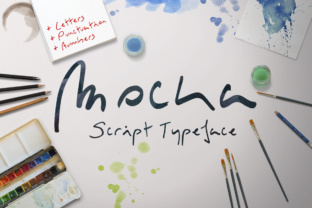
Mocka: A Hand-Painted Script Font for Crafters & Small Shops
If you’ve ever spent hours tweaking letter spacing on a candle label, squinting at tiny text on a sticker mockup, or second-guessing whether your wedding invitation font feels warm *and* professional—you’ll understand why Mocka landed in my cart and never left. This isn’t just another script font. Mocka is a smooth, hand-painted script typeface—drawn entirely by hand—with four distinct styles that work together like trusted tools in your design kit.
What makes Mocka special isn’t just its charm—it’s how it *performs*. As someone who designs printable planners, laser-cut wooden signs, SVG files for Cricut users, and physical product labels for local boutiques, I need fonts that look handmade *and* hold up in production. Mocka Regular gives me elegant flow for greeting cards and welcome boards. Mocka Bold adds confident presence to tote bag prints or farmhouse-style wall art. And because it’s truly hand-drawn—not digitized or traced—it carries subtle texture, natural variation, and gentle rhythm that feels human, not algorithmic.
I use Mocka most often for short, high-impact phrases: “Hand Poured,” “Made With Love,” “Small Batch,” or names on baby shower invites. Its readability shines at sizes 18pt and up—perfect for die-cut tags, chalkboard-style signage, and mug decals. On small stickers (think 1” x 1” thank-you seals), I stick to Mocka Bold with minimal letters—like “Yes!” or “Joy”—and avoid tight kerning. For printed cards and packaging, I always preview in grayscale first: Mocka’s soft edges translate beautifully to matte paper and soy-based inks without bleeding or muddiness.
Real-world uses? Last month, I designed a set of seasonal candle labels for a local apothecary. Using Mocka Regular for the scent name (“Lavender & Rain”) and Mocka Bold for “Small Batch • Hand Poured” created instant hierarchy—and customers told me the labels felt “thoughtful, not generic.” I also used Mocka in an SVG bundle for Silhouette users: layered with a clean sans serif (I love Montserrat Light), it made editable quote art feel boutique-ready. For wedding stationery, Mocka’s warmth helps soften formal layouts—pair it with a crisp serif like Playfair Display for invitations where elegance meets approachability.
Font pairing matters—especially when your brand lives across digital downloads, physical products, and social media graphics. Mocka thrives alongside neutral, highly legible companions. Try Mocka Bold for headlines + Open Sans for body text in printable planner pages. Or layer Mocka Regular over a light geometric sans (like Poppins) in Canva templates—this combo keeps your brand identity consistent whether someone’s viewing your Etsy listing on mobile or printing your PDF checklist at home. Avoid pairing Mocka with other busy scripts; its personality needs breathing room.
Here’s what’s included in the Mocka family: Mocka Regular, Mocka Bold, and two additional unique styles (the description mentions “4 unique fonts,” though only two names are fully visible—always check the full listing for Mocka Swash or Mocka Alternate, which often add flourishes ideal for logos or monograms). All files come in standard OTF and TTF formats—fully compatible with Cricut Design Space, Silhouette Studio, Adobe Creative Cloud, and free tools like Inkscape and Canva. No extra plugins needed. While the current details don’t list multilingual support, Mocka covers full Latin character sets—including accented characters used in French, Spanish, and German—so it works well for bilingual shop tags or international printable bundles.
Readability on cutting machines is where many script fonts fail. Mocka succeeds because its strokes are intentionally open and generous—not overly connected or spindly. When I convert Mocka text to outlines for SVG export, the paths remain clean and cut smoothly on vinyl and cardstock. For small-format stickers (under 1.5”), I avoid using Mocka for full sentences—stick to one- or two-word accents instead. And if you’re designing for embroidery digitizing, Mocka’s structure translates well to satin-stitch outlines when simplified slightly in vector software.
Let’s talk licensing—because this is non-negotiable for sellers. Mocka is a commercial font, meaning you’re fully cleared to use it in physical products (mugs, shirts, tags), digital downloads (PDF printables, Canva templates), SVG files, client work, and even merchandise sold via Etsy, Shopify, or craft fairs. Just be sure your license includes extended commercial use—some vendors offer separate tiers for unlimited sales or POD platforms. Always read the EULA before bundling Mocka into a template pack or reselling it as part of a design asset library.
What sets Mocka apart in the Script Amp category isn’t novelty—it’s reliability. It doesn’t shout. It doesn’t distract. It invites. That quiet confidence is why it shows up so often in my best-selling listings: on kraft-paper gift tags, in watercolor-style digital wall art, on lavender-scented soap labels, and in minimalist baby milestone cards. It supports your product instead of competing with it.
If you’re building a cohesive brand identity—or just tired of fonts that look great on screen but fall flat when printed, cut, or stitched—Mocka earns its place in your core font folder. It’s the kind of typeface that makes customers pause, smile, and think, “This was made with care.” And in handmade commerce, that feeling? That’s worth every penny.